


Fact sheet patents
No European country files more patents per capita than Switzerland. Patent protection is an essential prerequisite for research and development and a cornerstone of Switzerland’s prosperity. In plant breeding, patents and plant variety protection safeguard investments in new technologies and guarantee breeders access to genetic diversity.
Published: 29.06.2023, 15:25
Key points
- Switzerland has the highest number of patent applications per capita in Europe, filed by large corporations, SMEs, start-ups and universities.
- Plant varieties as such generally cannot be patented.
- New techniques and seed traits can only be patented if they meet the high threshold of an inventive step.
- Both the Patent Act and the Plant Variety Protection Act guarantee all breeders free access to plant material for further breeding.
- Databases such as PINTO make patented inventions publicly accessible and facilitate licensing.
The requirements are very stringent. A patent can only be filed if the invention is novel compared to the current state of the art and is based on an inventive step. Something that is already known or that occurs in nature is not a patentable invention. This also applies to plant breeding.
No Patents on Plant Varieties: Two Protective Mechanisms in the Seed Sector
In general, no patents can be filed for plant varieties. However, two proven mechanisms still provide the necessary innovation protection for seed research and guarantee that breeders can always rely on the greatest possible genetic diversity for further development.
- Novel techniques and seed properties may be protected under patent law if they are sufficiently inventive to meet the criterion for obtaining a patent. The hurdles are very high. In addition, the Patent Law recognizes a specific breeder's exemption. All breeders may use patented material for the breeding of new plant varieties at any time. The resulting new variety may be marketed without a license, provided that it no longer contains the patent-protected material. If the new variety contains the patented feature or technique and profits from it, a corresponding license must be negotiated with the patent owner.
- The Plant Variety Protection Act secures the ownership rights of breeders concerning new plant varieties. The granting of a plant variety protection title grants the breeder the right to protect the investment he has made over the course of many years from illegal commercial use. The Plant Variety Protection Act also recognizes a breeder's privilege. This exception guarantees that the use of plant varieties for further breeding remains possible for all breeders at any time without the authorization of the plant variety protection holder. As soon as a new breed is sufficiently different from the previous one, the new variety can be protected.
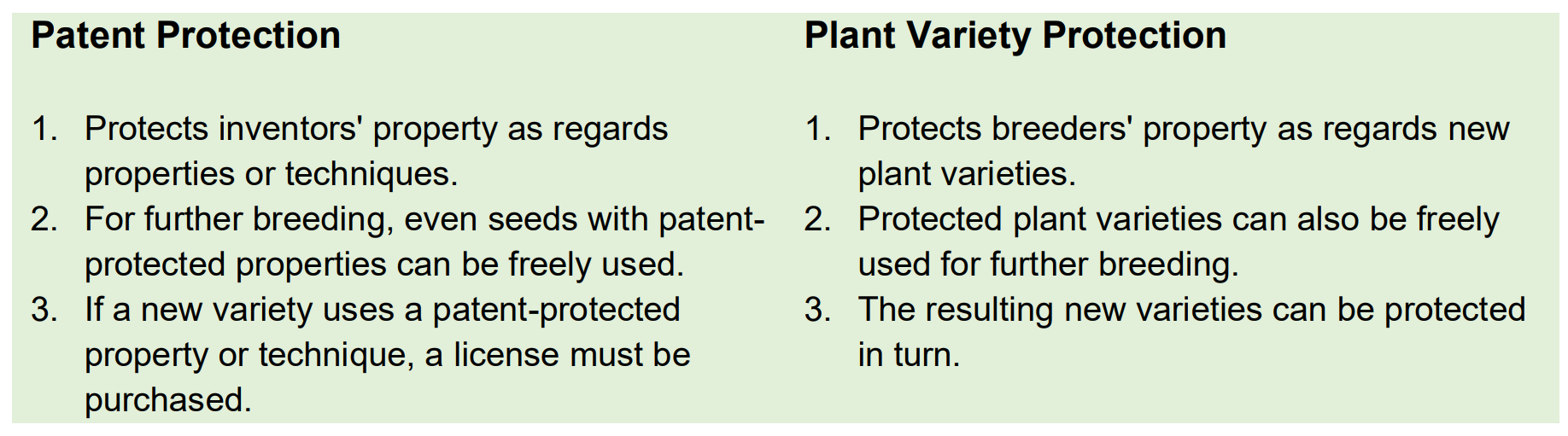
Patents ensure transparency and guarantee access
This is how protection in plant breeding has been working for almost a hundred years. Both proprietary protection mechanisms are limited in time (patents have a term of 20 years, plant variety protection a term of up to 30 years) and ensure that breeders and farmers can rely on the highest possible genetic diversity. This will not change if new breeding technologies are allowed.
While in plant variety protection the extensive breeder's privilege guarantees that the important diversity of varieties is extended, patent law is based on a transparent patent pool for the further development of novel techniques and properties. On platforms such as PINTO (patent information and transparency online), the inventions are made publicly available and, in contrast to the «trade secret', described in detail. For researchers and breeders, the patent pool forms an important basis for their own research activities and offers easy access for the purchase of desired properties or techniques. Each actor is also dependent on transparency and easy licensing. Innovation only works if inventors can recoup their research investments through revenue.
About swiss-food.ch
swiss-food.ch is an information platform run by the research-based food and agricultural technology sector, bundling fact-based content on nutrition, agriculture, crop protection, and biotechnology. The articles are editorially prepared, and the sources used are linked within the text. The platform is supported by Syngenta and Bayer.
Keywords: Patents · Plant breeding · Plant variety protection · Protection of innovation · Breeder's privilege · Seeds · Switzerland · Transparency
Can plant varieties be patented?
No, patents generally cannot be filed for plant varieties. Only novel techniques and characteristics of seed material can be protected by patent law, provided they demonstrate a sufficient inventive step.
What is the breeder's exemption in patent law?
The breeder's exemption allows all breeders to use patented plant material at any time to breed new varieties. The new variety may be commercialised royalty-free, provided it no longer contains the patented trait.
How does plant variety protection differ from patent law?
Plant variety protection protects a specific plant variety from commercial use for up to 30 years. Patent law protects technical inventions or traits for 20 years. Both systems secure access to genetic diversity through breeders' privileges.
How is transparency ensured for patented plant traits?
Platforms such as PINTO (patent information and transparency online) describe inventions in detail and make them publicly accessible. This patent pool facilitates breeders' own research and licensing.
Why are patents important for Switzerland as a business location?
Switzerland files the highest number of patents per capita in Europe. Patent protection forms the reliable legal position that enables and amortises investments in research and development in the first place.
What requirements must be met for a patent to be granted?
An invention must be novel compared to the state of the art and based on an inventive activity. What is already known or occurs purely naturally cannot be patented.
Sources
Kindly note:
We, a non-native editorial team value clear and faultless communication. At times we have to prioritize speed over perfection, utilizing tools, that are still learning.
We are deepL sorry for any observed stylistic or spelling errors.
Related articles

Protecting Innovation, Ensuring Access: Transparency for Patented Plant Traits
All breeders depend on access to genetic material. However, patents on plant traits are a subject of critical discussion, as they could potentially restrict access to breeding material. At the same time, clear rules exist to regulate both the protection and the use of intellectual property. This Swiss-Food Talk demonstrates how licensing platforms and legal frameworks ensure transparency, thereby promoting progress in breeding.

36 times the yield per square metre – thanks to indoor farming
Berlin-based start-up OrbiFarm is revolutionising the production of plant proteins and medicinal plants with indoor farming. The potential is enormous: yields are up to 36 times higher than in traditional agriculture – and that's without soil, weather or long transport routes.

«Patents on technically produced plant traits make perfect sense»
Scienceindustries is sceptical about the federal government's plans to set up a clearing house for plant patents. The chosen approach is problematic and leads to legal uncertainty and additional work for patent holders. This is a shame, because Switzerland is actually the world patent champion.

«Switzerland is the most patent-intensive country in the world»
Patents protect innovation and at the same time they drive innovation. During our Swiss-Food Talk on August 15, three innovation experts discussed the importance of patents for the Swiss economy.