
Food Security Initiative: Why Do the Goals Cancel Each Other Out?
The popular initiative "For a Secure Food Supply" calls for a self-sufficiency rate of 70 percent. At the same time, it demands drastic restrictions on crop protection and the promotion of open-pollinated seeds. The Federal Council also confirms that this balancing act does not work: a higher degree of self-sufficiency combined with severe restrictions on crop protection is not realistic.
Published: 15.09.2026, 08:04
In brief
- Unattainable self-sufficiency target: The initiative demands an increase in the self-sufficiency rate from today's 42.5 to 70 percent, but severely restricts the production means required to achieve this.
- Conflict of objectives in crop protection: The Federal Council confirmed in a response to an interpellation by Centre National Councillor Martin Candinas that a higher degree of self-sufficiency with strong crop protection restrictions is not realistic and resource efficiency would decrease.
- Threat of crop failures: Crops such as rapeseed, potatoes, fruit, and vegetables rely on crop protection products. Basel-Country farmer René Ritter, for instance, suffered two total crop failures within three years in chickpea cultivation due to a lack of protection options.
- Yield loss due to seed demand: The requested shift to open-pollinated seeds lowers yields, as widespread hybrid varieties yield significantly higher harvests due to the heterosis effect – up to 30 percent more for corn. This would lead to more food imports and higher prices for consumers of regional Swiss products.
- Lack of practical relevance: Implementing the demands without yield improvements would massively restrict consumer freedom of choice. Furthermore, state intervention in agriculture would become even greater.
Rarely has a popular initiative faced such a tough stance in parliament as the so-called "Food Security Initiative", which will be voted on on September 27. The request sounds tempting at first glance: Switzerland should become more independent in terms of food and increase its self-sufficiency rate from today's 42.5 to 70 percent.
However, a look at the text of the initiative and agricultural practice quickly reveals that the demands fundamentally contradict each other. It was launched by Franziska Herren, who already failed at the ballot box in 2021 with her Drinking Water Initiative. Back then, she also wanted to reduce pesticides and solve it via direct payments. Herren is mistaken. The assumption that farmers simply want to be compensated financially for waiving these tools falls short. Being a farmer means wanting and being able to produce food.
Less crop protection, higher yield – how is that supposed to work?
The initiative aims to simultaneously strengthen the cultivation of plant-based foods and drastically restrict the use of crop protection products. However, crops such as rapeseed, potatoes, fruit, and vegetables are precisely the ones reliant on effective crop protection to prevent losses caused by pests, fungal diseases, or extreme weather conditions.
The Federal Council outlined this conflict of objectives in its response to an interpellation by Centre National Councillor Martin Candinas: a higher level of self-sufficiency combined with a severe restriction of crop protection is not realistic. Additionally, the Federal Council stated that resource efficiency would decline – meaning the yield in relation to inputs used, such as land, labor, water, and fertilizer.
The consequences of missing crop protection products for Swiss producers are demonstrated by the example of Basel-Country farmer René Ritter in growing protein crops: due to a lack of effective protective agents, he suffered two total crop failures in chickpea cultivation within three years. Instead of the expected harvest of two to three tons, he was recently only able to harvest a single wheelbarrow full.
The seed contradiction: lower yields for higher expectations
The second, often overlooked contradiction concerns seeds. The initiative calls for the promotion of "natural, open-pollinated seed and planting material" – varieties whose seeds farmers can multiply themselves. The argument of initiator Franziska Herren: a growing share of imported seeds consists of non-reproducible hybrid varieties that must be repurchased every year. More open-pollinated seeds, according to her logic, would strengthen the independence of the food supply, implying that farmers want to propagate their own seeds.
The problem: hybrid varieties produce significantly higher yields than open-pollinated varieties thanks to the so-called heterosis effect – up to 30 percent more in the case of corn. That is why they have long been the standard for growing corn, sugar beets, rapeseed, and many types of vegetables in Switzerland. Farmers – whether organic or conventional – are not looking to propagate their own seeds, even though they are allowed to do so for their own use under plant variety protection law. They require high seed quality and therefore rely on certified seeds from specialized breeding companies. If open-pollinated seeds were generally promoted more strongly, the overall yield of Swiss agriculture would drop, along with agricultural income and the self-sufficiency rate that the initiative actually aims to increase. Hybrid varieties are by no means environmentally harmful – on the contrary: through their high yields, they help keep the land area required per ton of food produced smaller and conserve natural resources.
The motives behind the demand are understandable: independence from global seed corporations and the preservation of genetic diversity. However, this goal cannot be achieved free of charge – the price for it is a lower yield, which is the exact opposite of what the initiative promises. In short: the initiative is dishonest. Something is promised to the people, but the implementation and management of target conflicts are left to the legislature.
Nebelspalter editor Alex Reichmuth also highlights the issue: increasing the self-sufficiency rate to 70 percent while simultaneously introducing restrictions could only be enforced if large segments of the population switched to a purely vegan diet. This not only ignores actual consumer needs but also massively restricts citizens' freedom of choice.
SVP National Councillor Ernst Wandfluh takes the same line. The Food Security Initiative is a label fraud. "At first glance, the initiative sounds sympathetic. But in the end, it brings the exact opposite. Because a state mandate to primarily eat and produce plant-based foods is counterproductive," he writes on Nau.ch. Especially in mountain regions, livestock are an essential component of a sustainable diet. They make an essential contribution to security of supply, the maintenance of our cultural landscape, and the preservation of mountain areas.
Markus Ritter, President of the Swiss Farmers' Union, also finds using more arable land for food instead of animal feed senseless, as the Centre National Councillor stated to "10 vor 10". The consequences of accepting the Food Security Initiative would be a weakening of the domestic agricultural and food industry as well as an increase in food prices. Practically all agricultural associations support the "No" campaign of the Farmers' Union. Only BioSuisse and the Smallholders' Association decided on a free vote. This is particularly astonishing because organic farming relies specifically on liquid manure as fertilizer, as synthetic fertilizers are not permitted.
Innovation and sustainability instead of anti-liberalism
The Food Security Initiative pursues romantic approaches that are hardly feasible in practice. To genuinely strengthen our food security, exactly the opposite is needed: openness to technology, targeted innovation in plant breeding, practical crop protection, and a market-oriented agricultural policy (AP2030+). This is the only way to combine ecological, economic, and social sustainability.
About swiss-food.ch
swiss-food.ch is an information platform run by the research-based food and agricultural technology sector, bundling fact-based content on nutrition, agriculture, crop protection, and biotechnology. The articles are editorially prepared, and the sources used are linked within the text. The platform is supported by Syngenta and Bayer.
What does the Food Security Initiative demand?
The popular initiative "For a Secure Food Supply" demands an increase in the Swiss self-sufficiency rate to 70 percent while simultaneously waiving effective crop protection and promoting open-pollinated seeds.
Why is a higher self-sufficiency rate with less crop protection unrealistic according to the Federal Council?
Crops such as rapeseed, potatoes, fruit, and vegetables require protective products against pests and diseases. Without them, yields and resource efficiency drop, which undermines the target of a higher self-sufficiency rate.
What is the difference between open-pollinated seeds and hybrid varieties?
Open-pollinated seeds can be multiplied by farmers themselves, but often yield less. Hybrid varieties utilize the heterosis effect and deliver up to 30 percent higher yields, for example in corn.
What are the practical consequences of missing protective products for farmers?
Without effective crop protection, massive crop failures threaten. An example is Basel-Country farmer René Ritter, who suffered two total crop failures in chickpea cultivation within three years due to a lack of protective products.
What does the agricultural industry demand instead of the Food Security Initiative?
Demanded are openness to technology, targeted innovation in plant breeding, practical crop protection, and a market-oriented agricultural policy (AP2030+) to sustainably combine ecology and economy.
Keywords: Food Security Initiative · Self-sufficiency rate · Crop protection · Seeds · Hybrid varieties · Food security · Franziska Herren · Agricultural policy
Sources
Kindly note:
We, a non-native editorial team value clear and faultless communication. At times we have to prioritize speed over perfection, utilizing tools, that are still learning.
We are deepL sorry for any observed stylistic or spelling errors.
Related articles

Less than 50 percent: How Switzerland is squandering its self-sufficiency
Swiss agriculture is under enormous pressure. Extreme weather conditions, pests and increasingly stringent regulations are putting producers under strain. As a result, self-sufficiency is falling dramatically, especially for plant-based foods. To ensure food security in Switzerland, effective plant protection products are urgently needed.

Promoting healthy eating and preventing regional cultivation
There is a contradiction between nutritional recommendations and agricultural policy: the federal government wants us to eat more fruit, vegetables and plant-based proteins. At the same time, however, it is making it impossible for farmers to protect their crops.
A Superfood with Benefits and Challenges
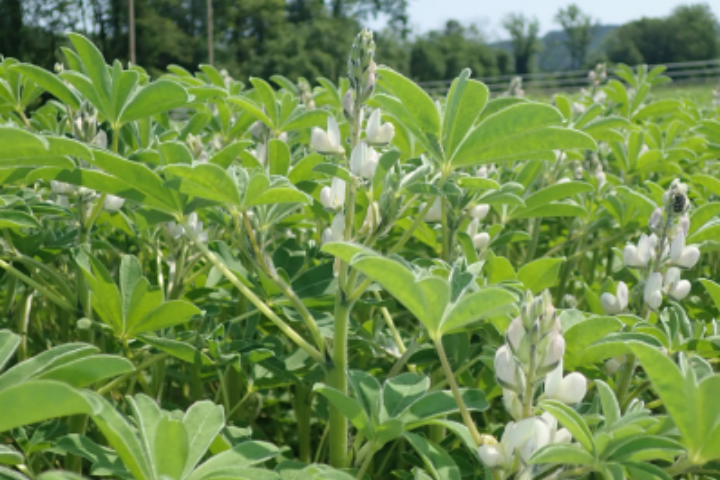
Sweet lupin is Biovision’s “Superfood of the Year 2026.” It delivers high protein content, improves soils and supports biodiversity. Yet a closer look at agricultural practice shows that without breeding, crop protection and innovation, even this superfood remains a challenging crop.
Agriculture and trade secure our food supply
The No to the Food Initiative is clear. It is an opportunity to free supply policy from wishful thinking. A sense of reality has returned to the political debate. Switzerland needs an agriculture sector that is able to produce food, and reliable trading partners for what it cannot produce itself.

Security Risk on the Plate: "We Are Extremely Vulnerable"
Hans Jörg Rüegsegger (SVP) has been a member of the National Council representing the Canton of Bern since 2023. A certified master farmer and agricultural technician (Agro-Techniker HF), he manages a farm in the Emmental valley specialising in dairy farming and arable crop production. As the former President of the Bernese Farmers' Association, he has first-hand knowledge of the entire value chain in Swiss agriculture.
Assess scientifically instead of banning indiscriminately
The debate surrounding PFAS is gaining momentum in Switzerland. At its core are questions about potential risks to human health and the environment, as well as future regulatory approaches. A differentiated, science-based approach is essential – as emphasised by scienceindustries in a short interview with Dominique Werner, Head of Chemicals Regulation.
Faster Approval of Crop Protection Products Long Overdue
Switzerland diligently bans active substances that have also been withdrawn from the market in the EU. Conversely, it is dragging its feet: modern products that are approved in neighboring countries remain blocked. With the adoption of the amendment to the Agriculture Act, the National Council has now taken an important step toward faster approval of plant protection products.