

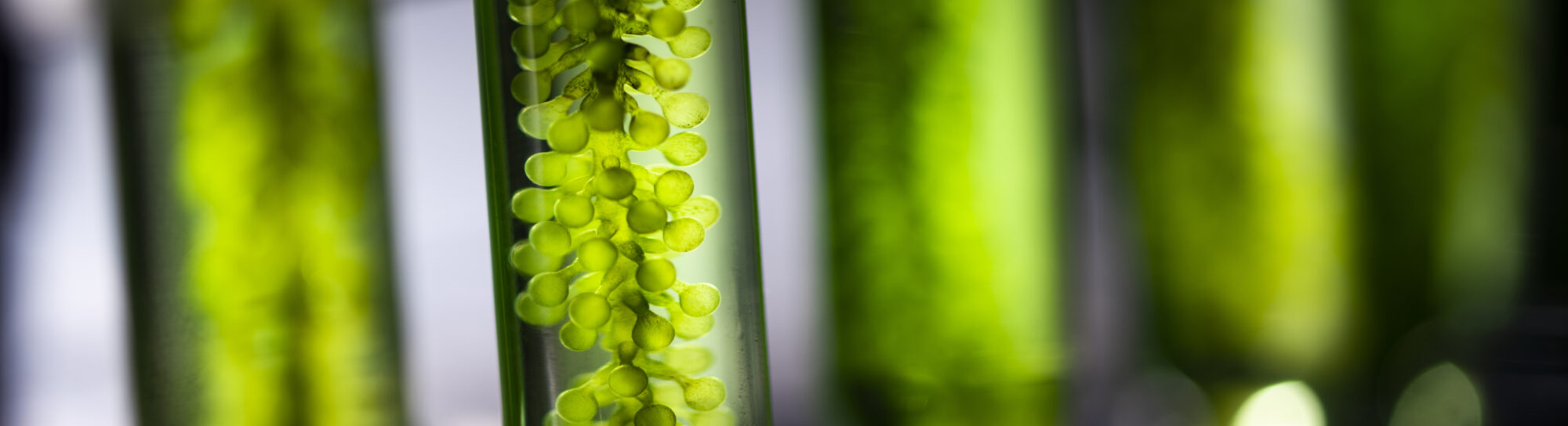
Sustainable nutrition with algae
The greatest challenge facing today's agriculture industry is to produce healthy foods that do not place undue stress on the planet. Algae could one day represent an important piece of the puzzle in food production. They are nutritious, space-saving and suitable as food for humans and animals.
Friday, November 12, 2021
According to the latest estimates by the United Nations, 9.7 billion people will be living on earth in 2050. Food production must keep pace with population growth. However, fertile land is scarce and should not be used for agriculture in order to preserve biodiversity and climate stability. In the future, we will therefore be dependent on food that does not grow directly out of the ground and is relatively space-saving. One example is algae - more precisely microalgae.
They are produced in bioreactors. Some of these systems have glass tubes several hundred kilometers in length in order to optimally capture the sunlight. However, there are also small facilities for local production. For example, production can also take place in the city, which is possible without further land use. Because the algae are rich in nutrients, they are ideal for consumption and as a component in dietary supplements. However, bio-plastics, medicinal agents against inflammation and infections with bacteria or viruses, and valuable cosmetic ingredients can also be produced using different types of algae.
Algae as animal feed
Algae could play an important role in nutrition indirectly as animal feed. One example is aquaculture - that is, the breeding of fish, mussels or crabs. They require feeds that are high in omega-3 fatty acids. The common practice is to feed them with fish meal. However, this is not resource-efficient. According to the FAO, approximately 19 percent of the fish caught in the wild are used for the production of fish meal or fish oil.
The production of algae oil from agricultural raw materials makes it unnecessary to process wild fish into feed meal and use it as feed for aquaculture. One ton of algae oil can replace over 60 tons of wild-caught fish. The MSC-certified algae oil from the company Veramaris – a joint venture between DSM and Evonik – can cover the feed requirements of close to 15 percent of global salmon and trout farming, thus replacing over one million tons of wild-caught fish every year that as a result do not have to be processed into fish meal.
Related articles
'Smallholder farmers produce 70% of the world’s food'
It sounds impressive and has been repeated for years. In 2026, the claim is once again being promoted by Fastenaktion: 'Smallholder farmers form the backbone of global food production.'
'Plant genetic diversity is disappearing'
It sounds alarming, has been repeated for years, and in 2026 was again claimed by the Fastenaktion organization: 'According to the Food and Agriculture Organization (FAO), more than 75 percent of plant genetic diversity has been lost over the past hundred years.'

Genetic Engineering in Everyday Swiss Life – “There’s a Gene in Everything!”
The genetic engineering moratorium in place since 2005 gives the impression that Switzerland is largely free of genetic engineering. However, a closer look shows that genetic engineering has long since become part of our everyday lives – we just usually don’t notice it.
Global facts on world food and agriculture
Only thanks to technological progress and modern crop protection will we be able in the future to conserve our resources while feeding a growing population in a healthy and affordable way.