
Full shelves today are no guarantee for tomorrow
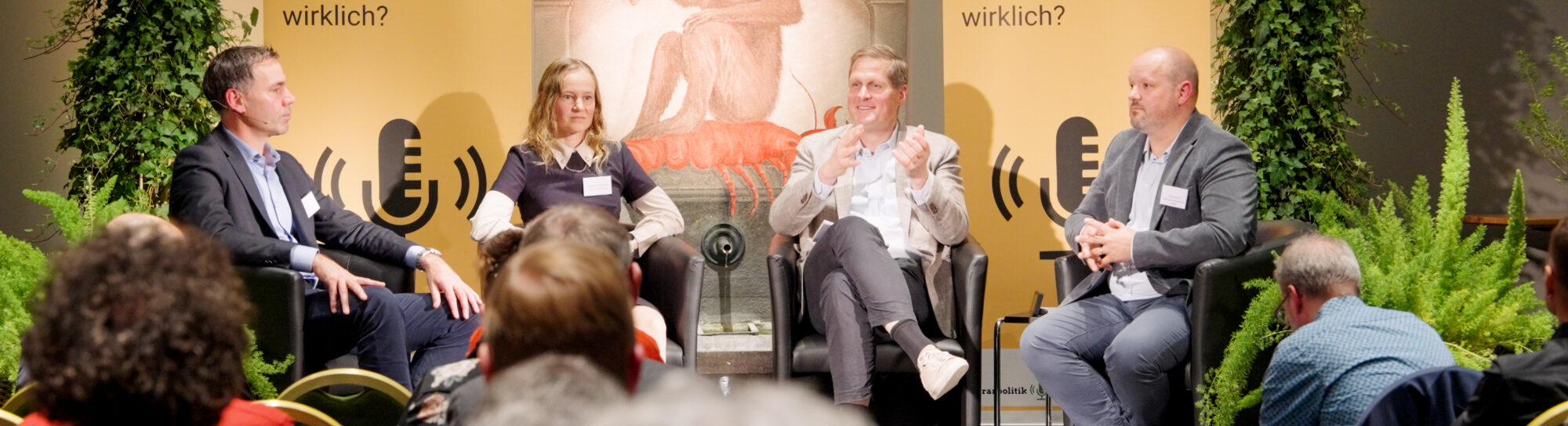
How can Switzerland keep its shelves full in the future? That was the question at the heart of the live podcast “Volle Regale – aber natürlich!” (Full shelves – of course!) at the Äusserer Stand in Bern on 5 November 2026. The event marked the conclusion of the joint podcast series by “Agrarpolitik – der Podcast” and swiss-food.ch.
Published: 17.11.2026, 09:46
Agrarpolitik – der Podcast + swiss-food.ch: “Fully shelves – of course!”, 5 November 2026
What it’s about
- On 5 November 2026, the live podcast « Full shelves - of course! » took place at the Äusserer Stand in Bern, marking the conclusion of the joint podcast series by « Agrarpolitik – der Podcast » and swiss-food.ch.
- The panel discussion was moderated by Andreas Wyss (« Agrarpolitik – der Podcast ») and featured Martin Rufer (Director of the Swiss Farmers’ Union), Rebecca Knoth-Letsch (Vision Landwirtschaft association) and Daniel Imhof (Head of Agriculture at Nestlé Switzerland).
- Food security is fundamentally based on domestic production, trade and compulsory stockpiles. However, the relative importance and specific details of these pillars remain controversial. One point of debate, for example, is whether a 50% share of domestic production should be regarded as a market-share target, or whether the focus should primarily be on what is produced and how many external inputs are required.
- In connection with the Mercosur free trade agreement, which was approved by Parliament during its autumn session, approximately half a billion Swiss francs have been earmarked to support agriculture.
- In addition to drought and heat in the fields, imported dough pieces pose a threat to the first stage of processing in the milling industry, while cyberattacks put cold chains at risk.
The host Andreas Wyss of “Agrarpolitik – der Podcast” opened the discussion with a simple question: When did you last find yourself in front of an empty shelf? Martin Rufer, Director of the Swiss Farmers’ Union, could not recall a single occasion – Switzerland, he said, is well positioned. Rebecca Knoth-Letsch of the association Vision Landwirtschaft, an agroecology-oriented think tank, recalled the toilet paper shortage during the coronavirus pandemic and the recent egg shortage. Otherwise, the panel – which also included Daniel Imhof, Head of Agriculture at Nestlé Switzerland – agreed: supply in Switzerland works.
There was also agreement in principle on how to keep the shelves full in the future. In a nutshell: security of supply rests on domestic production, trade and strategic stockpiling. The consensus ended, however, when it came to weighting and details. How much should be produced domestically – and what? How open should trade be?
How much domestic production is needed?
For Rufer, the rule is clear: production first. Only a country that produces enough at home can secure its supply, he argued. Yet he too recognises that the issue is complex – particularly given domestic producers’ dependence on foreign inputs. This is where improvements are needed: he is calling for Switzerland to have its own plant breeding and for more animal feed to be produced domestically. Agriculture also depends on functioning value chains, he added.
Imhof, by contrast, sees little point in fixating on percentages. Whether the self-sufficiency rate is 30, 50 or 70 per cent is secondary, he said – what really matters is what is produced domestically.
Rufer countered that 50 per cent domestic production also reflects Swiss agriculture’s claim to market share. Whether 30 or 50 per cent of food comes from Switzerland may not matter to Nestlé – but it does matter to farmers. And Nestlé, too, would probably not be indifferent if its own market share were to shrink.
For Knoth-Letsch, the level of domestic calorie production required is less decisive. The question, she said, is more fundamental: What kind of agriculture do we want as a society? She advocates more protein, though not necessarily from meat, and an agriculture that becomes less dependent on external inputs – that is, on purchased fertilisers, plant protection products, animal feed and energy – and on direct payments. To achieve this, agriculture must change and grow new crops. In general, domestic production should not be geared solely towards maximum output and preserving existing structures.
Trade: Yes – but on what terms?
How open Switzerland should be to agricultural imports has become a pressing question again, not least since the Mercosur agreement. In the autumn session, Parliament approved the free trade agreement – together with around half a billion Swiss francs in support for agriculture.
Imhof made it clear that Switzerland depends on trade – in both directions. It must also export, he said, because only those who put something into the market can take something out of it. Rufer, for his part, stressed that Switzerland has already concluded numerous free trade agreements and that farmers have always lent their support. They are therefore not fundamentally opposed to free trade. In saying so, he pre-empted the accusation that Swiss agriculture is protectionist. Accordingly, the Swiss Farmers’ Union is not backing the referendum against the Mercosur agreement – unlike Uniterre and the Small Farmers’ Association, for example.
Vision Landwirtschaft also supports the agreement in principle but demands that compensation payments reflect the actual damage and that imports be tied to binding environmental, social and human rights standards. In this vein, Knoth-Letsch stressed on the panel that trade agreements must comply with sustainability standards. Imhof pointed out that such standards are part of all new or renewed free trade agreements.
Climate change: Irrigate, adapt, breed
Naturally, the dry, hot summer was also on the agenda. How can Swiss agriculture maintain its production under increasingly difficult climatic conditions? “No water, no potatoes,” as Rufer put it. According to Rufer, farms are investing in irrigation and keeping larger feed reserves on site. Knoth-Letsch is counting on adapted cultivation – millet instead of potatoes – and on ecosystem-based practices with “natural resilience”. Technology is important, she said, but it is not the focus.
Imhof, for his part, warned that buying up animal feed abroad in times of drought is not a sustainable solution – the same problems prevail there.
Q&A: Mills, standards, cyber risks
The audience raised concrete questions. One concerned the state of the first processing stage – mills, slaughterhouses and the like, which are just as important for security of supply as production itself. Rufer pointed to problems in the milling industry: imported dough products are weakening domestic processing and demand for local grain and could thus jeopardise security of supply.
Another question addressed double standards: Is something permitted abroad that is banned in Switzerland? While Knoth-Letsch argued that imported food should have to be produced to Swiss standards, Imhof countered that Switzerland sets an example in many areas, but not in all – some requirements are even stricter abroad. The aim must be to enforce international standards or to declare differing standards transparently. And what about cybersecurity in cold chains? A major risk, according to Imhof, for Nestlé too. Food production is exposed, he said – it takes good people who respond correctly in an emergency.
Conclusion: Three pillars, plenty to discuss
At the end of the evening, the formula held: domestic production, trade and preparedness belong together. What remains contested is how strong each pillar should be. But the panel agreed that today’s full shelves are no guarantee for tomorrow. Climate change, fragile supply chains and new risks such as cyberattacks demand answers – in the field, in processing and in trade policy.
Agrarpolitik – The Podcast and swiss-food.ch explore key interdependencies and areas of tension surrounding security of supply in a joint series: between the market and the state, ecology and production, as well as self-sufficiency and international interconnectedness.
The following guests discussed these issues in the live podcast:
- Rebecca Knoth-Letsch, Managing Director of Vision Landwirtschaft
- Daniel Imhof, Head of Agriculture at Nestlé Switzerland
- Martin Rufer, Director of the Swiss Farmers’ Union
Host: Andreas Wyss, host of the Agrarpolitik podcast
Keywords: Security of supply · Swiss agriculture · Domestic production · Free trade · Mercosur Agreement · Climate change · Supply chains · Cybersecurity
About swiss-food.ch
swiss-food.ch is an information platform run by the research-based food and agricultural technology sector, bundling fact-based content on nutrition, agriculture, crop protection, and biotechnology. The articles are editorially prepared, and the sources used are linked within the text. The platform is supported by Syngenta and Bayer.
Related articles

Full Shelves – But of Course! How Secure Is Our Supply Really?
Security of supply sounds like a shared goal. However, as soon as it comes to the path to get there, conflicts arise: between market and state, ecology and production, as well as self-sufficiency and international connectivity. The Agricultural Policy Podcast and swiss-food.ch explore the key dependencies and areas of tension surrounding supply security in a five-part series. The highlight will be a live podcast in front of an audience on November 5, 2026, at the Äusserer Stand (Hofcafé) in Bern.
Domestic production as a blind spot
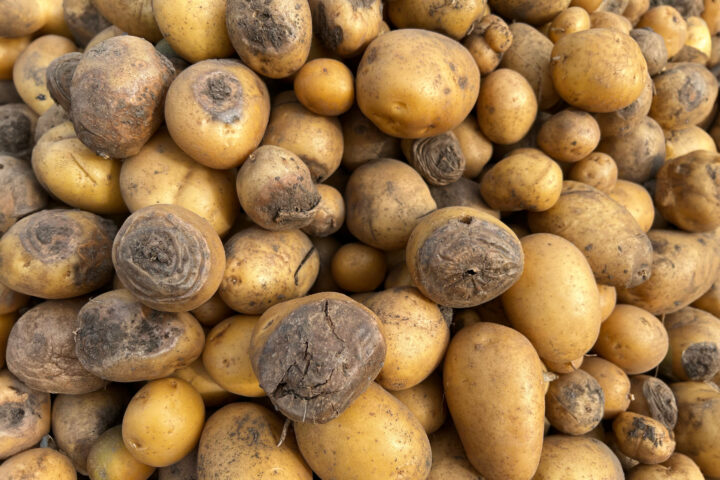
Switzerland's food security is increasingly under pressure: last year's disastrous wheat and potato harvests have led to an increasing dependence on imports. However, the report by the Federal Office for National Economic Supply (FONES) is largely silent on the precarious state of the domestic agricultural sector. The IG BauernUnternehmen (Farmers' Company) has therefore sharply criticised the federal government.
Security Risk on the Plate: "We Are Extremely Vulnerable"
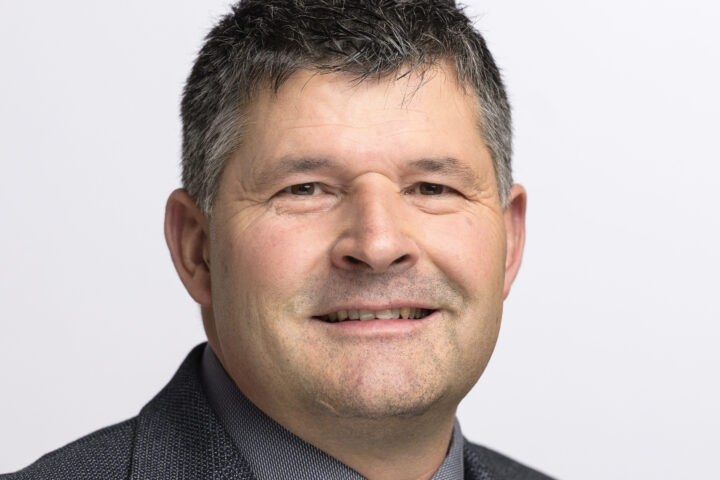
Hans Jörg Rüegsegger (SVP) has been a member of the National Council representing the Canton of Bern since 2023. A certified master farmer and agricultural technician (Agro-Techniker HF), he manages a farm in the Emmental valley specialising in dairy farming and arable crop production. As the former President of the Bernese Farmers' Association, he has first-hand knowledge of the entire value chain in Swiss agriculture.
Costly Disincentives in the Beet Field
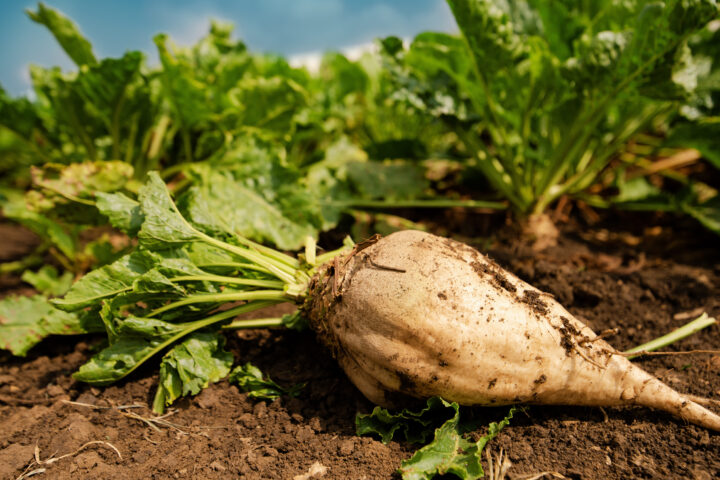
When the federal government and industry pursue conflicting goals, it gets expensive: while the Swiss Confederation pays beet farmers not to spray crop protection products, the sugar industry pays a special premium for spraying when needed. Processors, taxpayers, and consumers bear the costs.

Anti-Food Waste Banana
British biotech company Tropic has developed a banana using CRISPR/Cas gene editing that no longer turns brown. In the US, it is already on the market, while in England, it has passed the decisive regulatory hurdle. The same technology could also help save the world's most popular banana from extinction.
Asian Tiger Mosquito: Federal Government Implements Action Plan – But Insecticides Remain Taboo
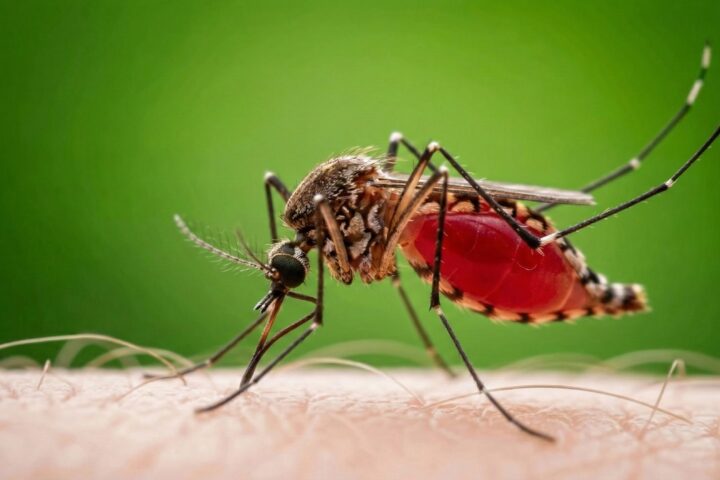
Invasive species such as the Asian tiger mosquito are increasingly spreading across Switzerland. The federal government is sounding the alarm and wants to put a stop to the mosquito with a national action plan. However, the most effective measure is being left out: insecticides.

Record Heat 2026: Why Agriculture Needs Resilient Crop Varieties
Heat, drought, and hail took a heavy toll on Swiss farmers in 2026. In an interview with the NZZ, Adrian Aebi, head of Switzerland's largest crop insurer, warns: "If we carry on like this, agriculture will bleed dry." Looking to the future, there is an urgent need for resilient crop varieties that can withstand heat and dry conditions.